


|
Are You Buying the Best Tractor Attachment, or Just the One They’ll Finance? Buy the tractor you want because it’s the right tractor. Buy the attachment you want because it’s the right attachment. A financing company shouldn’t be picking your grapple for you. Are You Buying the Best Tractor Attachment, or Just the One They'll Finance?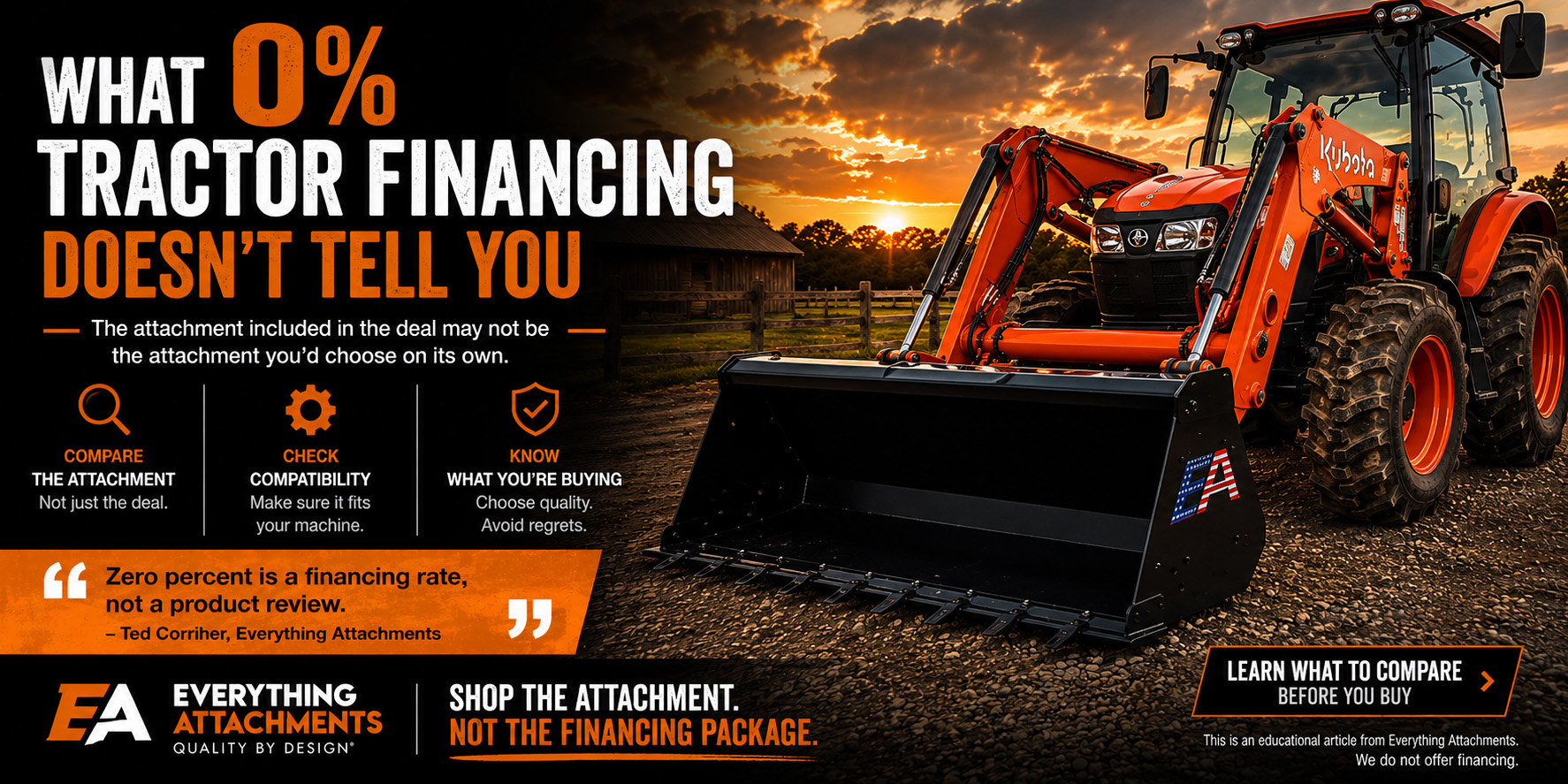
Buying a new tractor is a big decision. Buyers compare horsepower, loader capacity, transmission options, hydraulic flow, comfort, dealer support and price before deciding which machine belongs in the barn. So why should the attachments get any less consideration? 0% and other promotional financing offers can make a new tractor more affordable, and being able to roll qualifying implements into the same purchase can certainly be convenient. But the attachment that qualifies for the financing package isn't necessarily the attachment you would choose if you were shopping for it on its own. That leads to one question worth asking before adding another implement to the payment: If the financing wasn't part of the deal, would you still choose that attachment?
There's nothing wrong with 0% financing. In the right situation, it's an excellent way to purchase equipment while keeping cash available for other needs. The mistake is allowing the financing offer to become a substitute for comparing the equipment. Whether an attachment qualifies for promotional financing doesn't tell you its:
Those are equipment specifications. The interest rate isn't. Think about the amount of research that goes into choosing a tractor. Buyers compare horsepower, lift capacity, hydraulic capability and countless other specifications. The attachment doing the actual digging, grappling, grading or lifting deserves the same attention. Sometimes the economics really are that simple. If a dealer or manufacturer is including an attachment at no additional cost, or offering it for very little additional money, there's no reason to turn down something that has value. Take it. Use it. Keep it as a backup. Sell it and put the money toward the attachment you really want. It may even be perfectly useful while you're waiting for the attachment you selected for the long haul. A good deal is still a good deal. The important part is not allowing “free” or “included in the payment” to end your research. The name on the tractor hood doesn't necessarily have to be the name on every attachment connected to it. Many compact and utility tractors use common attachment interfaces, including the skid-steer quick attach system and standardized three-point hitch categories. That gives tractor owners access to a large aftermarket of implements designed for compatible machines. Compatibility still matters, of course. An attachment needs to match the tractor's mounting system, capacity, hydraulics and intended application. But once those requirements are satisfied, buyers can compare competing attachments based on how they're designed and what they can do, rather than simply whether the logos match. Different implements require different considerations, but there are several questions worth asking about almost anything you're going to put on a tractor. How much does it weigh?Attachment weight can be especially important on loader-mounted equipment. Every pound of attachment is weight the loader has to carry before you pick up the first rock, log or pallet. What is it made from?Thickness alone doesn't tell the whole story. Steel selection, structural design and where material is placed can be just as important as simply adding more of it. How is it designed?Geometry determines how an attachment interacts with the work. Tine shape matters on a grapple. Fork length and frame design matter on pallet forks. Cutting edges and scarifiers matter on a box blade. Is it appropriately sized for your tractor?Bigger isn't automatically better. Neither is heavier. An attachment should complement the capabilities of the tractor rather than unnecessarily consume them. What kind of support comes after the purchase?Parts availability, fitment knowledge and access to people who understand the equipment matter long after the credit card clears. Put two root grapples beside one another and they may appear to perform the same basic job. Look closer and the differences can become substantial. A tractor owner comparing grapples should consider overall weight, steel selection, tine geometry, jaw opening, hydraulic cylinder design and placement, hose protection, lid configuration and strength relative to weight. And they matter because a grapple doesn't work by itself. It's part of a system consisting of the tractor, loader, hydraulics, attachment and load. The best grapple isn't necessarily the biggest or heaviest one. It's the one whose design makes sense for the tractor and the work being performed. None of this means tractor buyers should avoid promotional financing. Quite the opposite. If a manufacturer is willing to finance the tractor you want at an attractive rate, take that into consideration. If the attachment included in that program is also the attachment you would independently choose, that's even better. Just make the two decisions independently. Your tractor might be with you for decades. The grapple, pallet forks, box blade, land leveler, bucket or other implements you choose may spend those same years doing the work you bought the tractor to accomplish. A convenient monthly payment shouldn't be the only specification you compare.
Everything Attachments approaches tractor and skid-steer attachment design from the perspective that an attachment should be engineered around the machine and the work it needs to perform. That means paying attention to strength without unnecessarily consuming machine capacity, selecting materials for the job they're being asked to do and developing attachment geometry around real-world equipment use. The goal isn't to tell tractor owners which color tractor to buy. It's to encourage them to put the same thought into choosing the equipment attached to that tractor. Finance the tractor you want. Take the free attachment if they're giving you one. But when you're choosing the equipment you plan to depend on for years, shop for the tool, not the financing package. |
QUALITY BY DESIGN®
•
AMERICAN-BUILT ATTACHMENTS